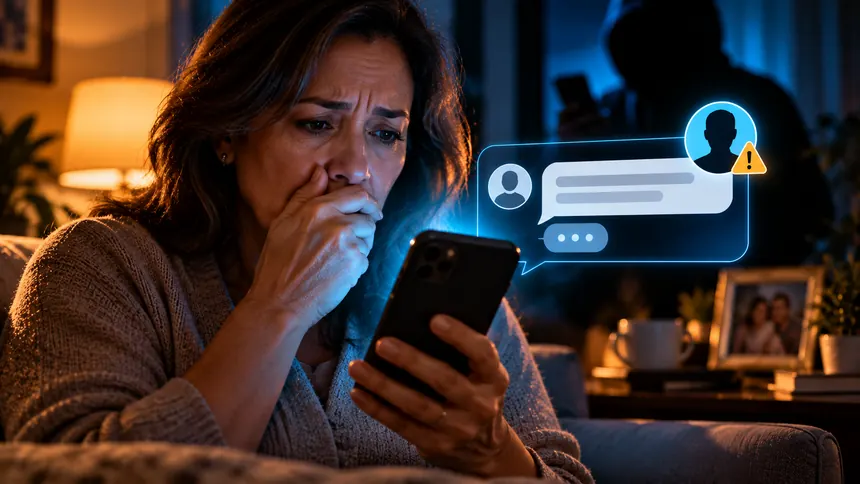
The “Hi Mom” text scam starts with a message from an unfamiliar number, by SMS, iMessage or WhatsApp: someone says they are your son, daughter or another relative, claims they have a new phone, and soon asks for money. The fix is one call: before you send anything, call the person on the number you already have saved. If you already paid, contact your bank or payment app right away and report the scam at ReportFraud.ftc.gov.
There is no malicious link to spot and no virus, just a believable story and pressure to act. Below: how the conversation usually goes, the warning signs, a step-by-step way to check, what to do for each payment method if money is already gone, and how to lower the risk for parents and grandparents.
How the scam unfolds
The FTC describes the family-emergency version of this scam: someone contacts you pretending to be a relative or close friend who is in trouble and needs money. Scammers may learn details from social media or a hacked email account, or simply guess, and some pose as an authority figure such as a lawyer, a police officer or a doctor. A typical text thread looks like this:
- “Hi Mom, I dropped my phone in water. This is my temporary number. Can you save it?”
- “I can't get into my banking app and I have a bill due today.”
- “Can you pay it for me? I'll pay you back tomorrow.”
- “It's just this once. Send it to this account and text me the receipt.”
Some versions open with “Hi Dad” or “Hi Grandma,” and some start with a call instead of a text. The shape stays the same: a relative, a new number, a problem and money.
Why it works so well
The first message gives you nothing to doubt: no link, no threat, just a child in a small crisis. The FTC lists the pressure tactics: the scammer says it is urgent and that you are the only one who can help, may ask you to keep it quiet so you don't check with anyone, and pushes you to act before you verify the story. The FTC also warns that scammers can use AI to clone a loved one's voice from a short audio clip, so a voice that sounds right is not proof. It is not gullibility; the script is built to work on emotion, and anyone can fall for it on a busy day.
The warning signs
- A message from an unknown number claiming to be a family member.
- An excuse for why they can't take a call: broken phone, no signal, bad connection.
- A fast jump to money: a bill, a transfer, gift cards, “just this once.”
- A request to pay into someone else's account or with a method that is hard to reverse.
- Pressure to hurry and to tell no one.
The call that stops the scam, step by step
- Stop talking about money in the thread. Expected result: you buy time and the scammer loses the urgency.
- Call the person on the number you already have saved, not the one in the text. The FTC says to contact the family member or friend using a phone number you already know is correct and ask whether they are really in trouble. Expected result: your real child picks up, safe and confused, and the case is closed. If the texter insists they can't talk, the scam is confirming itself.
- Can't reach them? Call another relative or friend to check the story, even if the texter asked you to keep it secret. That is the FTC's advice too.
- Ask a question only the real person could answer, or use a family safe word, the same idea as in our guide to AI voice scams.
- Don't trust the voice or the caller ID. Voice can be cloned, and the FBI notes that scammers can spoof numbers that look familiar.
- Block and report the number. WhatsApp's security page says reporting helps keep the app safe for everyone and that the sender is not told. Other messaging apps have their own block and report options.
Already sent money? What to do, by payment method
The FTC's advice is that no matter how you paid a scammer, the sooner you act, the better. Its guide on what to do if you were scammed breaks it down:
| How you paid | What to do now |
|---|---|
| Bank transfer, including Zelle | Report it to your bank or credit union immediately and ask them to reverse the payment. |
| Payment app (Venmo, Cash App, PayPal) | Notify the app right away and ask for a reversal and refund. |
| Wire transfer (Western Union, MoneyGram) | Report it to the wire company immediately, say a scammer tricked you and ask for a refund. |
| Gift card | Call the issuer using the number on the card, say a scammer tricked you into giving the card number and PIN, and ask for a refund. Keep the card and the receipt. |
| Cryptocurrency | Contact the exchange or ATM operator right away, say the transaction was fraudulent and ask them to reverse it. The FTC warns that crypto payments don't have the same legal protections as credit and debit cards. |
| Cash handed to someone who came to the door | Report it at once to your local FBI field office and at ic3.gov. In a related family-emergency scheme, the FBI warned in 2021 that criminals sent couriers, sometimes rideshare drivers, to collect cash at the victim's home. |
Then report the scam at ReportFraud.ftc.gov and to your state attorney general, as the FTC recommends. If you also gave out a Social Security number or other personal details, the FTC points you to IdentityTheft.gov for a recovery plan. Keep screenshots of the thread, the number and any receipts.
Reporting channels and bank procedures change. Check the FTC and your financial institution's own pages for the current steps.
Lower the risk for parents, grandparents and your team
- Agree on a family rule: nobody asks for money by text without a phone call first.
- Share less in public. The FBI advises limiting what you post on social media and dating sites, because scammers use those details to make their stories believable.
- Teach the one-call habit to older relatives before they need it. It takes two minutes and is the same check the FTC recommends.
- If you run a business, apply the same rule to payment requests “from the owner” sent from a new number: no payments or gift-card purchases without a confirming call to a known number.
Sometimes the text comes from your relative's real number because their account was taken over. See how that works in our guide to the WhatsApp 6-digit code scam. For the wider wave of message fraud, read about the text scams flooding phones.
Frequently asked questions
How do I know if a “Hi Mom” text is a scam?
If it comes from an unknown number, gives a reason the person can't be called and quickly asks for money, treat it as a scam. Verify by calling the person on the number you already have saved.
Should I reply to find out if it's really my child?
Don't rely on the text thread. Call or video-call the person on their known number. Keeping the chat going just gives the scammer time to pressure you.
Can I get my money back after sending it?
Sometimes. The FTC says that no matter how you paid, the sooner you act, the better. Contact your bank, payment app, wire company or gift card issuer immediately and ask for a reversal.
Where do I report a “Hi Mom” scam in the US?
Report it to the FTC at ReportFraud.ftc.gov and to your state attorney general. The FBI also takes reports of fraudulent or suspicious activity at ic3.gov.
Sources: FTC Consumer Advice: Scammers use fake emergencies to steal your money · FTC Consumer Alert: Scammers use AI to enhance their family emergency schemes · FTC Consumer Advice: What to do if you were scammed · FBI IC3 public service announcement: FBI warns of a grandparent fraud scheme using couriers (I-072921-PSA) · WhatsApp: security features, safety tools and tips